Paving Paradise, can it be a good thing?
Updated: Jan 25
Don't it always seem to go
That you don't know what you've got 'til it's gone
They paved paradise, put up a parking lot.
-Joni Mitchell
A small, community, non-profit organization with which I'm associated is facing urbanization pressures. Those pressures have forced me to examine myself. Self-examination is never a bad idea. However, self-examination requires a gentle hand. It's not a frivolous activity!
In North Texas, indeterminate grass that no longer serves an agricultural purpose and must be periodically mowed to keep scrub brush at bay (and the chiggers, ticks, poison ivy, and other dangers away) to protect innocent suburban children who might play there - grass expanse like that - is a net zero equation. I hate to kill the grass, but I also hate the fossil fuels that go into mowing it.
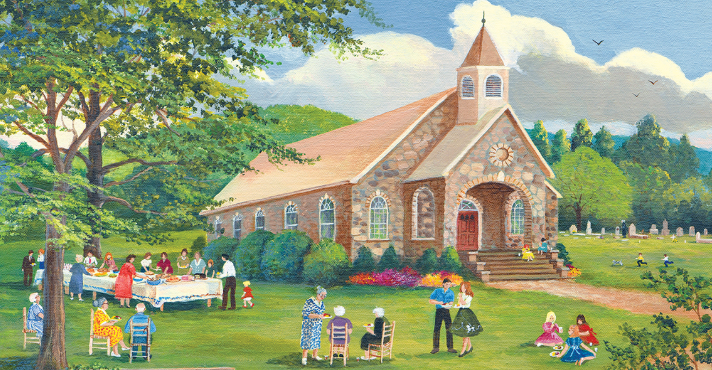
In our instance, the new neighbors to our organization need a bigger parking lot. We are going to have to move a landscape feature - that we have long held dear - in order to accommodate the paved lot. For clarity, it's not a natural landscape feature in and of itself. But it represents a time that is long gone, where neighbors met for potlucks. It used to be called "dinner on the grounds". It's sad to see it go. But, truth be told, nobody has met for a potluck there since the pandemic (we've moved inside to the air conditioning). And, prior to that, for many years, people only met once a year. It's been decades since it was used with regularity - more's the pity. So, it's only an emotional loss.
But, it's a loss. And, the fact that it is "only emotional" doesn't make it easier. "Place" is a powerful concept. From "The Well-Gardened Mind" by Sue Stuart-Smith:
Attachment to place and attachment to people share an ancestral source…smells, textures, sounds are strongly associated with feelings. The notion of place in modern life has increasingly been reduced to a backdrop. But, the notion of "place" is foundational. Our mother is the first sacred place we experience. And children naturally seek out a mother's arms and lap whenever they don't feel safe. This becomes a secure base. When the feeling of security is established, the child becomes emboldened to branch out but still keeps half an eye on its secure base where they can return. We are primed to seek reunion with our secure base!
Those of us who have an actual geographical "place" that evokes this powerful emotional response in us are very lucky indeed! Having a "place" to go back to is a powerful stabilizer.
Therefore, I find it logical, appropriate, and justified to mourn this change to my "place". Those community gatherings in that locale are the sacred "places" where my mind often goes to find safety. Every time I have returned physically, my sense of safety has been restored.
Nevertheless, transforming a place to serve its people is what we human beings do. And, the place I mourn is needed by new families with new children who have a need to live and make a place of their own in a new world. (And, I should mention, the landscape feature I'm losing is no longer a necessity - in a physical sense - to me nor to my organization.) This new world my neighbors are building requires places that look different than the ones I have loved.
But I do secretly hope for a day when those new families and new children get to experience a place like the safe one that I go back to in my mind's eye. I think they would become better versions of themselves if they did have that opportunity.


Comments